
YOU’LL NOT SEE NOTHING LIKE THE MIGHTY QUINN by Vaughan Ward
(click on images to enlarge)

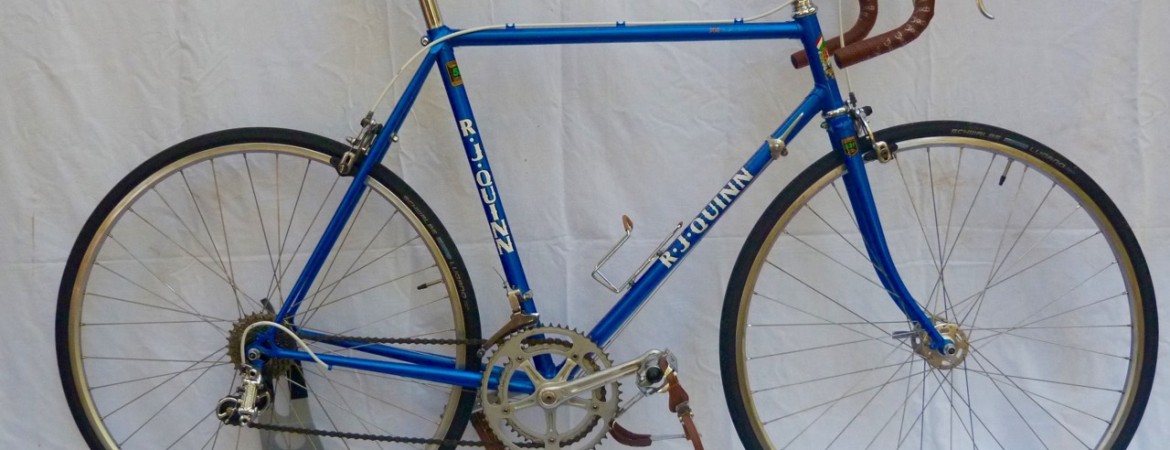
The original photo from eBay…..note the front mech….there isn’t one!
Back in 1968, as I was just starting to dabble in time trials as a teenager, my first few months wages went on treating myself to a hand built frame. Living in North Wales, the nearest builder of any note meant Liverpool. Those of you of ‘a certain age’ may have heard of the Quinn Bros frames. They went their separate ways as frame builders to be renamed ‘Harry Quinn’ or ‘R J Quinn’.
Harry’s products were far more commonplace; he was allegedly the better businessman. Ronnie and Jack were thought by some to be the better frame builder. But the R J Quinn is a much rarer beast and for no particular reason that’s what I bought back in the day.
Once I had finished transferring everything over from an old Falcon that had belonged to my brother, I entered the local 10TT (down the Conway valley) and somehow took the junior record. Something must have been right? Back to today. Rare though an R J Quinn may be, I nevertheless managed to track one down last November via eBay. It was not quite complete, it was tatty, wrong colour, wrong components and four years younger than my original. But at least I had a starting point for a winter project! The winter project took 7 months.

Not much left of the head badge, and plenty of rust
I’ve now bought a number of bikes from eBay and have always driven to wherever to check them all out first. Except this one. And sure enough, there were a few surprises when the courier delivered it, that didn’t show on the photos. In particular, quite a few dents on the frame and a nasty looking crease on one of the seat stays. The latter was almost certainly as a result of using brute force to open up the back end in order to squeeze in a modern wheel with a wider axle and thus more cogs on the cassette. Therefore, something akin to Jeremy Clarksonesque engineering skills had resulted in dangerously weakening the frame whilst taking it away from its original profile/geometry. Not nice. The stem was seized solid in the head tube. Not unusual for an ageing alloy and steel ‘quill’ interface; chemical reactions and all that. More of that later. Otherwise, I managed to strip it down to the bare frame ready for a respray.
Then I came across the retro bike bits specialist in High Wycombe (just round the corner from Simon’s ‘Cycle Care’). Some of you will know of this unusual chap by the name of Francis Thummer who trades under the name ‘Hard To Find’. That applies to his premises and to the retro bits he sells. My lifelong military background is such that I’m conditioned to put everything away in exactly the right place, in an orderly manner, with a system for location, and last but not least for the work area to be spotlessly clean. It is therefore clear that Francis, umm, is not ex-military. I’m not sure what he is; a visit to his ‘store’ is quite an experience for those whose brain functions like mine, as his store is a ‘Lion, Witch and a Wardrobe’ thing into another world at the other end of the spectrum that I inhabit. However, there is no doubting his knowledge and experience.

The stripped frame (with circled dents) ready for refurbishment
Back to the naughty seized stem. I had used plusgas over several days to try and free it, but that didn’t work. YouTube came up with alternatives to soaking in plusgas, not least heating the headtube with a blowtorch. That didn’t work either. Then a friendly club member (you know who you are, Jon) confidently and helpfully used a very long steel bar for extra leverage. Shortly after, I delivered the frame to Francis Thummer, complete with broken/sheared stem firmly corrosively ‘welded’ into the headtube. He too was confident that his solution would win the day and thus re-soaked the head tube but this time totally submerged in a bath of plusgas. There it stayed for over a month. Nope. Careful use of a drill, to reduce the alloy stem to a container full of swarf, was the only way. Then it went away to the UK’s ‘centre of excellence’ for frame refurbishment; the unfortunately named Argos of Bristol (no, not that Argos, the other one). Several weeks later, the frame was like new, dents and creases sorted with molten brass, jig straightening, dropouts correctly set etc. Argos are licensed by Reynolds to apply the usual 531 sticker to classic refurbished frames. Perhaps the only ‘nice’ surprise I received when I unwrapped the old banger all those months ago was to discover it was made from 531c, the not so common competition variant. The ‘c’ probably makes it an ounce or two lighter. Weight weenies were alive and well even back then. But prior to the top lacquer coat going on, the so-called ‘decals’ were the problem.
There are several firms out there who can provide stickers using the exact font of the day for the likes of Holdsworth, Claud Butler, Henry Hall, Hetchins and the like. But not R J Quinn. Harry Quinn: yes. But not mine. I eventually found a ‘digital sign-writer’ who was able to replicate the font from photographs I sent him of what was left of the name transfers on the rusty red banger. A superb job resulted at only double the cost of ‘off-the-shelf’ retro stickers. But the difficulty surrounded the head badge. The banger had little of it left; erosion and time had taken its toll.
Then I discovered the shop still existed where I bought the original bike from back in ’68. It was trading under the name ‘Quinn Cycles’. No Quinns were part of that dealership any longer; most probably gone to the grand peloton in the sky. But of course the dealership no longer made bespoke 531 frames. Instead, they were selling all the usual modern off the peg stuff including Specialized, Trek and the like. However, from a phone call they put me onto one of their mechanics who had been there for over 30 years, including working for Ronnie and Jack Quinn. I told him the tale and he seemed quite delighted that I was bringing the old warhorse back to life. So much so that he was able to lay his hands on a head transfer. To the purist, it wasn’t quite of the right era, but there was nothing else out there so I was very glad, indeed relieved, to receive it and send it on to Argos.

After Argos Racing Cycles had had it for weeks
Wheels. Back in the day, it was necessary to own large flange hubs. Without them, club members would think you inferior. So of course, as a keen teenager, I saved up and bought a pair with my humble wages as an office junior. The red banger turned up with the usual small flange and the wrong brand. They had to go. My originals were Zeus – back to the hens teeth scenario again. I tracked down a similar French pair (large flange Campag hubs fetch Abramovich money on eBay) in excellent condition. But then on closer inspection, all the old spokes were brittle and ropey looking and the Weinmann rims were way past their best. So, new spokes were purchased together with new rims of a pattern that look ‘classic’. These (together with the leather saddle – not a Brooks, too pricey, but a credible copy) came from the excellent Spa Cycles; helpful and knowledgeable in the extreme.
So to building the wheels. After lots of YouTubing and reading, it didn’t seem that difficult to someone with a technical background. The wheel building jigs seemed unnecessarily pricey so I made one from bits of softwood offcuts.

New Head badge, Reynolds 531 stickers and Campag headset
I found building the wheels to be very straightforward. However, building round wheels was a different matter. For them to be round and true was altogether more challenging. But round, true and for the rear wheel to be asymmetrically dished to precisely the correct degree…..oh my goodness. The serene fortitude of a Saint is mandatory. Mick Moss lent me several books on the subject, and a tensioning gauge too. Thanks Mick. But I had to supply my own patience, literally many days-worth. Despite the double chainset, the bike had no front mech strangely enough, so eBay coughed up an affordable Campag. The rear mech was a nasty alloy/plastic Simplex thing. Chris German coughed up so I gave him a tissue. His ex-Campag rear mech is one of the few things I’ve bought that didn’t need sorting and polishing. Thanks Chris.
Nasty (presumably British) chrome and rust headrace and bottom bracket were replaced with super shiny alloy Campag units. A replacement ITM stem was found, along with a smaller inner chainring, replacement Campag brake levers and shifters (on the downtube – of course!). I did my best to use an electric polisher on the alloy parts but a handful went away to be professionally polished. And that’s more or less it, seven months on and, umm, a few hundred guineas more than I had budgeted for.
Come the first test ride, all was well. Everything in alignment, no nasty surprises, gears as slick as can be. It felt absolutely fine. I joined my wife the following Sunday with Group 5 as I knew that pace would be nice and steady so I could take it all in and listen out/feel for adjustments. None needed.

Polished groupset on, Campag bottom bracket, it’s coming together
First impressions? Well, for those who didn’t ride back in the days of monochrome TV, I need to tell you that perhaps the most obvious difference is not just the weight, it’s the gearing. Not just the fact that you have to move your hands a long way down from the bars to find the shifters, and then spend 2, 3 even 4 seconds setting the derailleur position for a quiet ride, but the actual ratios. For reasons that escape me, we were much more high-geared back then. Even if you were lucky enough to afford 10-speed, the smaller chainring would usually be in the mid-40s and the 5 or 6 speed cassette quite often the equivalent of a ‘standard’ today in terms of range. So, for a mature retiree like myself, living in the heart of the hilly part of the Chiltern Hills, not ideal.
I managed, with the careful use of a file, to make a 41 tooth chainring fit the BCD. The Campag rear mech is strictly speaking beyond its design limits with the 28T 1st gear, but a diligent feel, good hearing and mechanical sympathy means it just copes with a 28T. Just. But for 1st gear to be 41/28, it is still high geared. I won’t compromise though, and work around the problem by fitting a modern groupset. It’s not in keeping with its provenance.
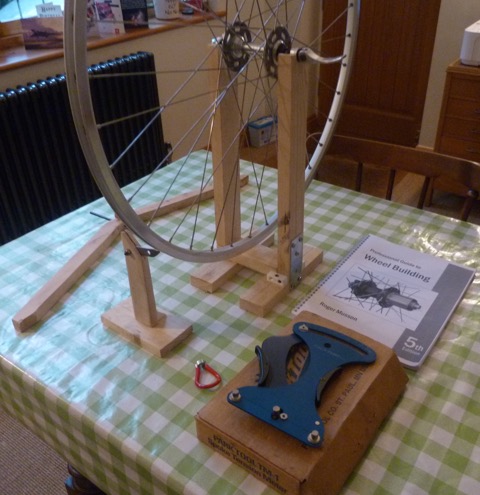
Wheel building – not a hobby for the impatient or faint hearted
A couple weeks after its launch, I thought I might surprise a few club riders and give it a bit of a workout. I usually ride with Gp2 these days but realised that would be a big ask when we came to the hills on the Mighty Quinn. So I turned up one Sunday morning, stepped back one and joined Gp3 on Liverpool’s (Everton’s?) finest. I haven’t worked that hard in a long time.
I was having to push the old body on the hills to stay in touch. Come the coffee break, I was very glad to take a breather. But then an hour or so later, it was the infamous Rignall Road mad dash. I wouldn’t class myself as a sprinter at the best of times, but on this occasion I was very much a spectator from the back row. It was a timely reminder of the progress that bicycle design has made over the decades. It shouldn’t be surprising.
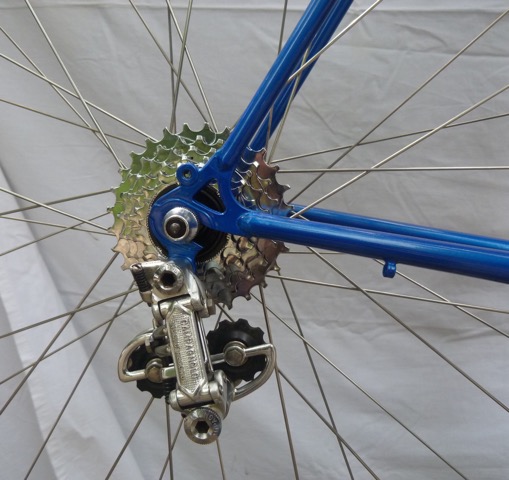
Replacement Campag mech and ‘new’ rear wheel
After all, if one compares a modern day hatchback with a Ford Anglia or Morris Oxford – similar vintage to the bicycle comparison in question, then cars are demonstrably very much better today in all departments. But of course they look so different. Whereas a bicycle, well, for many decades it’s been a triangle with a wheel at each end and a pair of pedals in the middle. Slightly lighter nowadays (unless you’re comparing a flyweight £10K Madone with a £20 thing from Halfords back then), slightly different geometry, clickety-click gears.
But what else are the differences? Ask Mr Brailsford, and he’ll bang on about marginal gains. Or was it Sir Clive Woodward before him, back in the day when we used to win at rugby? Whatever the answer is, there will always be a place in my heart (and garage) for my restored classic. Maybe not on Kop Hill though. That said, you young fellas and ladies on your plastic rockets, you don’t know what you’re missing!

A labour of love; but for me, well worth it